RC Workbench
Professional inspection and service documentation for serious RC owners.
Stop guessing with high-end RC cars.
RC Workbench builds structured checklists and service notes alongside real teardown, inspection, and rebuild work — so you can reduce costly mistakes and make decisions with confidence.
Built by a professional mechanic, translating high-end automotive inspection habits to RC.Practical documents you can use trackside, at the seller’s bench, or in your own workshop.
All RC Workbench resources follow the same lifecycle:
inspect before you buy, then service and maintain methodically.
Step 1 — Pre-Purchase Inspection Checklist
Before any service or upgrade work makes sense, the condition of the vehicle needs to be assessed properly.This free checklist documents the inspection process used to evaluate used RC cars before purchase, adapted from protocols used in high-end automotive applications.
Chassis, drivetrain and suspension inspection points.
Electronics, wiring, fastener checks
Signs of normal use versus abuse and neglect
Common red flags that turn a "good deal" into an expensive rebuild.
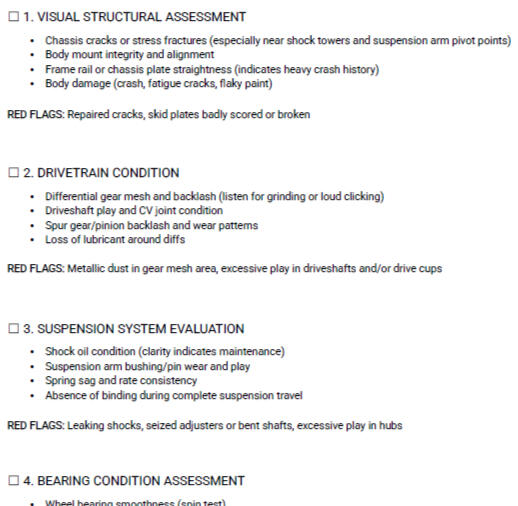
It is intended as the first step in a structured inspection and service workflow.
You’ll receive the requested PDF immediately after email confirmation, plus a small set of follow-up bench notes over the next couple of weeks to help you apply it. From there, you’ll only be notified when new inspection or service documentation is released. Unsubscribe anytime.RC Workbench will never sell your data or use it for unrelated marketing.
Step 2 — Service & Maintenance Checklist (In Development)
A structured, model-specific service checklist is in development, built as the companion document to RC Workbench teardown and rebuild videos.It will cover:
• Service and inspection checkpoints
• Wear considerations and part references
• Baseline setup and tuning notes
• A repeatable workflow to reduce oversight during reassembly
Release notices go to email subscribers.These are model-specific documents, not generic guides
RC Workbench documents mechanical processes as they are applied in practice.Resources are released only once they reflect a complete, repeatable, and defensible workflow.
© RC Workbench
Privacy PolicyRC Workbench respects your privacy and is committed to handling personal data in a transparent and responsible manner.1. What data is collected
RC Workbench collects email addresses when visitors voluntarily subscribe
to receive documentation or updates related to RC Workbench resources.No additional personal data is collected.2. Purpose of data collection
Email addresses are collected solely for the purpose of:
• Delivering requested documentation (such as inspection checklists)
• Notifying subscribers when new RC Workbench inspection or service resources are releasedEmail addresses are not used for unrelated marketing purposes.3. Data processing and storage
Email data is stored and processed using Kit (formerly ConvertKit),
an email service provider that complies with the General Data Protection Regulation (GDPR). Data may be processed in the US; transfers safeguarded via DPA/SCCs (and where applicable DPF).You also have the right to lodge a complaint with your local data protection authority.RC Workbench does not sell, rent, or share subscriber data with third parties.4. Subscriber rights
Subscribers may unsubscribe at any time using the link provided in each email.Subscribers may also request access to, correction of, or deletion of their personal data by contacting RC Workbench directly.5. Data retention
Email addresses are retained only for as long as the subscriber remains subscribed or until a deletion request is made.6. Privacy-friendly analytics (Plausible). We use Plausible Analytics to measure overall website usage (e.g., page views, visits, referrers, approximate location at country/city level, and which buttons/links are clicked) so we can improve this website and understand what content is useful. Plausible does not use cookies and does not create persistent identifiers to track you across websites. To produce aggregated statistics, Plausible processes limited technical information that is sent with every web request (such as IP address and user agent) but does not store raw IP addresses; it uses an anonymized, daily-rotating hash to calculate unique visitors. The data is used only for statistical purposes and is not sold or shared for advertising. Our legal basis is legitimate interest in operating and improving the website. You can object to or prevent this analytics processing at any time by blocking JavaScript for this site or by using an ad-blocker that blocks requests to Plausible.7. Contact
For any questions regarding this privacy policy or personal data,
you may contact RC Workbench via [email protected]
Last step: confirm your email.
Check your inbox for a confirmation email — once you click confirm, the PDF will be delivered.This is step one in removing guesswork from buying a used RC — a practical, repeatable reference to help you spot expensive problems before money changes hands.How to use it (so it actually pays off):Save it on your phone so it’s with you when you go to view a car.Or print it and keep it in your kit — it’s designed to be used in the real world, not admired on a screen.What to do next:Check your inbox (and spam/promotions if it doesn’t show up).Save the PDF somewhere you’ll find it fast: phone + a printed copy if you can.Already own a UDR (or you’re past the buying stage)?
If you want the same workshop-grade approach for reliability and maintenance, the deeper documents live on Patreon — starting with the Post-Run Service Checklist.Step into the Workshop - Have a look and see if it’s useful for you.
Not into Patreon? No problem.
I’ll also email subscribers when new checklists, manuals, and tools go live — so you can grab what you need when it’s relevant.